 Inverse finance
: fixed-rate borrowing, stablecoins and governance
Inverse finance links FiRM fixed-rate DOLA borrowing, the DOLA stablecoin and INV-led governance in one DAO-managed DeFi system. Borrowers use collateral to create DOLA debt while DBR is consumed over time. Holders can choose yield-bearing token forms, while INV voters influence configurable limits and incentives. Each path changes a different on-chain state and carries different failure conditions.
Choose among these paths by matching the intended outcome to its requirements. Liquidity, stable-value exposure, yield and governance participation involve different assets, on-chain states and monitoring burdens.
FiRM fixes borrowing costs through DBR, while collateral health, DOLA’s peg and governance parameters remain variable.
Three paths depend on the state you want to change
FiRM is the borrowing path. A user deposits an asset accepted by a specific collateral market, borrows DOLA and maintains enough DBR to cover the debt over time. The observable output is an open position with recorded collateral, DOLA debt and a declining DBR balance. Suitability depends on that market’s capacity, collateral rules and live risk parameters.
Holding DOLA creates no FiRM debt by itself. It provides exposure to a debt-backed stablecoin that targets the US dollar, with market liquidity and peg behavior determining its practical value. Depositing DOLA into sDOLA adds a yield-bearing wrapper and its contract dependencies. INV serves a different purpose: governance participation and staking-related benefits. Staked INV can also serve as collateral for DOLA borrowing where its FiRM market permits it. These routes can overlap, but none substitutes automatically for another.
A usable position starts with live market conditions
Borrowing requires more than owning a crypto asset. FiRM must have an active market for that collateral, available borrowing capacity and a valid price input. The collateral factor, liquidation threshold, borrow limit and DBR market price determine whether the intended debt can be opened on acceptable terms. Governance or delegated operators may change configurable parameters, so an old screenshot can’t establish the conditions of a new transaction.
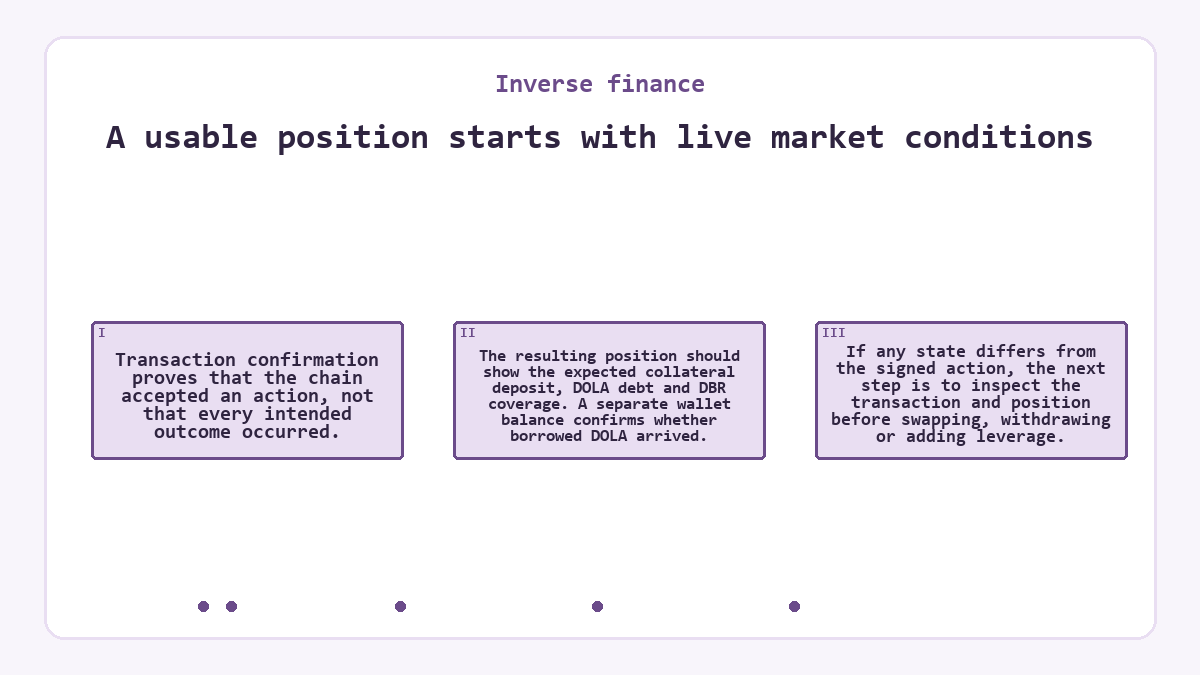
Transaction confirmation proves that the chain accepted an action, not that every intended outcome occurred. The resulting position should show the expected collateral deposit, DOLA debt and DBR coverage. A separate wallet balance confirms whether borrowed DOLA arrived. If any state differs from the signed action, the next step is to inspect the transaction and position before swapping, withdrawing or adding leverage.
DBR turns borrowing time into an explicit cost
FiRM doesn’t apply a conventional variable interest rate to DOLA debt. It consumes DOLA Borrowing Rights while the loan remains open, making debt size and time the main inputs to coverage.
Coverage follows debt and duration
One DBR grants the right to carry one DOLA of debt for one year, with the balance consumed continuously while that debt remains open. The relationship can be expressed as required DBR equals DOLA debt multiplied by the intended coverage period in years. Partial years scale proportionally, and repaying debt reduces the rate at which DBR is consumed.
A fixed cost still has market inputs
Buying sufficient DBR establishes the borrowing cost for the covered debt and period at the acquisition price. It doesn’t set the future DBR price. Extending the loan may therefore cost more or less than the original coverage, while unused DBR remains transferable after debt is repaid. Gas, swap execution and any later replenishment are separate from the initial DBR purchase.
Collateral health and DBR coverage fail differently
A FiRM position has two independent maintenance duties. Collateral must remain above the market’s required level, and the borrower must keep a nonnegative DBR balance while DOLA debt is open. Satisfying one condition doesn’t repair the other.
Negative DBR triggers replenishment
If the DBR balance becomes negative, a third party can trigger replenishment, which adds DBR to the borrower’s wallet. The protocol adds the cost to the borrower’s DOLA debt and prices that replenishment above an ordinary market purchase. Repeated replenishments can increase debt until the position reaches its collateral limit. A borrower can prevent that chain by adding DBR or reducing DOLA debt before the balance becomes negative.
Collateral pressure triggers liquidation
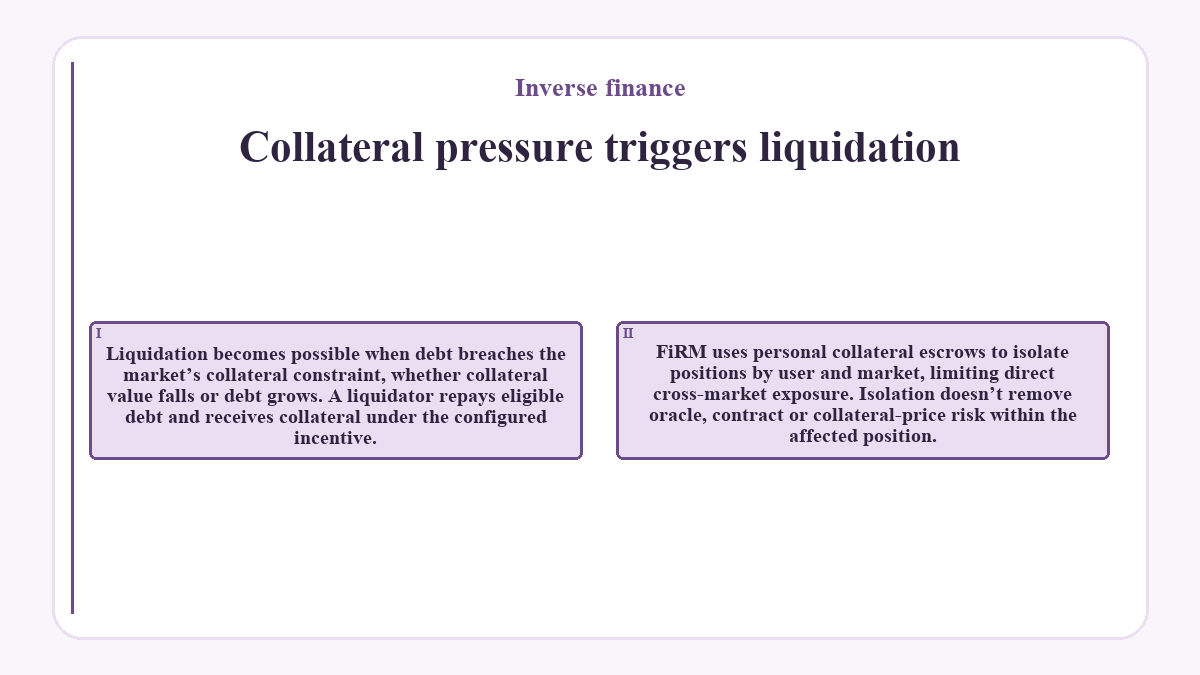
Liquidation becomes possible when debt breaches the market’s collateral constraint, whether collateral value falls or debt grows. A liquidator repays eligible debt and receives collateral under the configured incentive. FiRM uses personal collateral escrows to isolate positions by user and market, limiting direct cross-market exposure. Isolation doesn’t remove oracle, contract or collateral-price risk within the affected position.
DOLA supply responds to debt and market demand
DOLA is a debt-backed stablecoin designed to trade near one US dollar. Its peg is soft rather than a promise that every trade will execute at exactly one dollar. Borrowing, repayment, market liquidity and protocol-controlled supply facilities all influence how closely it trades to that target.
Borrowing expands debt-backed supply
FiRM can supply DOLA to approved collateral markets within configured limits. When a borrower draws DOLA, the new circulating amount is matched by recorded debt and collateral requirements. Repayment reverses that state by reducing the debt and removing the repaid DOLA from circulation. Market-level and global capacity limits constrain how far this route can expand.
Peg support has its own capacity
The Peg Stability Module provides a separate exchange path between DOLA and a supported reserve stablecoin. Its fees, reserves and operating limits are configuration-dependent rather than permanent constants. Market participants may also borrow or repay when DOLA trades away from its target, but gas, DBR costs and available liquidity affect whether that activity is economical. A soft peg can still deviate during stressed or thin markets.
Governance controls the parameters around fixed contracts
INV carries voting power in the DAO’s on-chain governance system. Proposals can govern risk limits, collateral markets, incentives, treasury actions and authority delegated to operational groups. Token ownership and voting authority aren’t always identical in practice because a holder may delegate voting power while retaining control of the tokens.
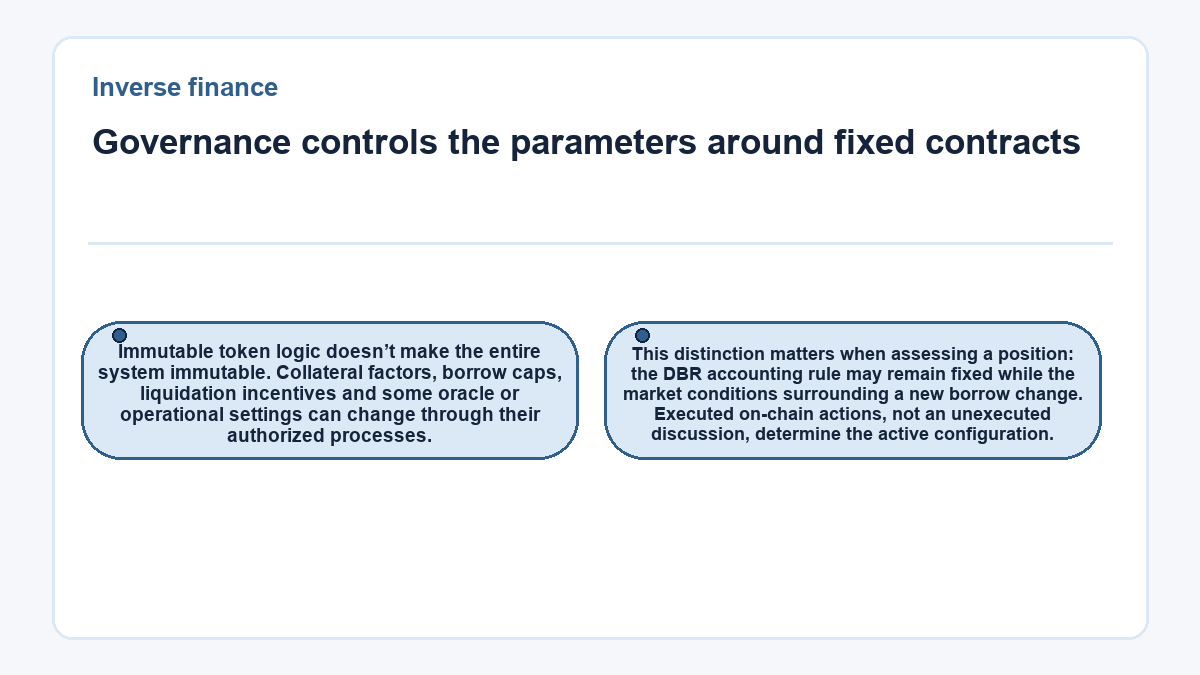
Immutable token logic doesn’t make the entire system immutable. Collateral factors, borrow caps, liquidation incentives and some oracle or operational settings can change through their authorized processes. This distinction matters when assessing a position: the DBR accounting rule may remain fixed while the market conditions surrounding a new borrow change. Executed on-chain actions, not an unexecuted discussion, determine the active configuration.
Acceptance checks before choosing an action
Define success by the on-chain state that the intended action should produce. These checks separate a completed transaction from a hoped-for financial outcome:
- Confirm that the intended collateral has an active FiRM market with usable borrowing capacity.
- Read the live collateral constraint and choose debt that leaves room for adverse price movement.
- Price enough DBR for the intended duration and set a top-up or repayment point before coverage expires.
- Check DOLA liquidity for the intended use without assuming every venue will execute at one dollar.
- After signing, verify the recorded collateral, DOLA debt, DBR balance and received tokens independently.
If the supported configuration can’t produce the required state, changing the amount may not solve the problem. A different collateral market, a direct DOLA acquisition or no transaction may fit better, depending on which prerequisite is missing.
Yield-bearing wrappers add another dependency
sDOLA represents DOLA deposited into a yield-bearing contract. Its return comes from protocol revenue associated with FiRM rather than a fixed rate promised to the holder. The rate can change as borrowing activity, DBR economics and governance allocations change. A holder also retains exposure to DOLA’s peg and adds risks tied to the wrapper contract.
sINV packages staking-related value into a transferable vault token, but the deposited INV doesn’t retain on-chain voting rights. Direct INV staking on FiRM can preserve governance participation and support borrowing against the staked position where the market permits it. The two forms don’t create identical states. A reader choosing between them should distinguish voting access, collateral use, withdrawal mechanics and the way rewards accumulate instead of comparing a single displayed yield.
The next choice is the state you can monitor
Fixed-rate borrowing narrows one uncertainty: the DBR acquired for a defined debt and period establishes that portion of the cost. It leaves collateral prices, DOLA liquidity, smart-contract behavior and future configuration changes exposed. A borrower must monitor both collateral health and DBR coverage, while a DOLA holder focuses more on the peg and available liquidity.
Governance participation shifts the task again. The relevant evidence becomes delegated voting power, proposal status and executed on-chain changes. Yield-bearing wrappers require attention to their exchange value and revenue source. The next decision is which state can be observed and maintained reliably. A high displayed rate doesn’t answer that question.
Inverse finance: frequently asked questions
-
Can a FiRM loan be repaid before all purchased DBR is consumed?
- Yes. A borrower can repay some or all DOLA debt before the DBR bought for an intended period has been consumed. Repayment reduces the debt that causes DBR to stream away, and full repayment stops consumption for that loan. Any DBR left in the wallet remains a transferable token rather than becoming an automatic refund. Its market value may differ from the original acquisition cost, and the repayment transaction also incurs network gas.
-
Do I need INV to borrow DOLA through FiRM?
- No. FiRM borrowing requires collateral accepted by an active market, enough available borrowing capacity and sufficient DBR coverage. INV is one asset with its own role in governance and may be usable as collateral where its market is active, but it isn’t a universal prerequisite for borrowing DOLA. The relevant requirement comes from the selected collateral market’s live configuration, including its collateral factor, capacity and any restrictions on new debt.
-
Is DOLA redeemable for US dollars by the DAO?
- DOLA’s soft peg doesn’t create a general promise that the DAO will redeem each token for fiat currency. Its price is supported by debt repayment, market liquidity, supply management and the Peg Stability Module’s configured stablecoin exchange path. That module depends on supported reserve assets, capacity and active fees. A holder therefore faces market execution and smart-contract conditions even when DOLA trades close to its one-dollar target.
-
Can INV voting power be delegated without transferring the tokens?
- Yes. An INV holder can delegate voting power while retaining control of the underlying tokens. Delegation changes who can cast the associated votes, not who owns the assets, and the holder can change it by re-delegating for future proposals. Voting power must be delegated before the proposal goes live. A delegate’s choice may differ from the holder’s preference, so proposal history and current delegation state are the useful records.
-
Which costs can change after a FiRM borrowing cost is locked?
- Future DBR purchases, Ethereum gas, swap execution and liquidation-related charges can still change. The DBR already acquired fixes its purchase cost and covers a defined combination of debt and time, but it doesn’t lock the market price of additional DBR. Extending a loan may therefore have a different cost. Replenishment is also separate and adds DOLA debt at a premium if the borrower’s DBR balance becomes negative.
-
Does sDOLA pay a fixed yield?
- No. sDOLA’s yield varies with the protocol revenue allocated to its mechanism, which depends partly on FiRM borrowing and DBR activity. A displayed rate is a changing observation rather than a permanent term. Holding sDOLA also adds contract risk and retains exposure to DOLA’s soft peg. Withdrawal value follows the wrapper’s accounting for its underlying assets, so a holder should distinguish the vault exchange value from DOLA’s market price.
-
Are FiRM collateral positions cross-collateralized?
- FiRM uses personal collateral escrows that isolate positions by user and collateral market rather than combining every asset into one shared collateral balance. Collateral in one position doesn’t automatically support debt in another. This structure limits direct spillover between markets, but it doesn’t make an individual position risk-free. Its collateral price, oracle input, debt balance, DBR coverage and market parameters still determine whether that position remains healthy.
Updated on