 Inverse finance
: starting records and outcome checks for FiRM positions
Inverse finance position changes are easier to judge when the starting condition and intended outcome are recorded before the transaction. Capture the wallet, collateral market, deposited collateral, DOLA debt and DBR balance. After confirmation, compare those fields with the state the action should produce. A matching receipt and position update show completion. A receipt without the expected change calls for diagnosis, not an immediate retry.
The short version: A reliable FiRM check pairs a pre-transaction position record with the confirmed on-chain state that the intended action should create.
Record the position before changing it
A useful starting record identifies the account and the exact FiRM market being changed. Note the deposited collateral, current DOLA debt, available borrowing capacity, DBR balance and displayed depletion time. If the action involves collateral risk, record the credit limit or liquidation information shown for that market. Include the observation time because collateral valuations and DBR coverage can move while a transaction waits for confirmation.
Keep the public wallet address and transaction hash with the record. They distinguish one account and action from another without exposing wallet secrets. A screenshot can preserve the interface summary, but it shouldn’t replace the on-chain receipt and updated position. Define the expected change before signing: which balance should rise or fall, which field should stay unchanged and what value would show that the action finished.
Tie each action to a measurable state change
Each FiRM action affects a limited set of position fields. That makes the intended outcome testable rather than a matter of whether the interface displayed a success message.
- A collateral deposit should increase deposited collateral in the selected market without creating DOLA debt by itself.
- A DOLA borrow should increase recorded debt and deliver the amount described by the confirmed transaction summary after any included DBR purchase.
- A partial repayment should reduce DOLA debt, while unused DBR remains available and continues covering the smaller outstanding balance.
- A DBR purchase should extend borrowing-right coverage. It doesn’t repair inadequate collateral or reduce existing debt.
- A collateral withdrawal should reduce the deposited amount and the associated borrowing room, provided the remaining position permits the withdrawal.
Compare values from the same wallet and collateral market. A correct transaction in another market won’t satisfy the intended change, even though it succeeded on-chain. An approval transaction also isn’t the underlying deposit, repayment or borrow. Approval changes token spending permission; the position changes only after the action that uses that permission is confirmed.
Did the intended state change?
The check passes when the confirmed on-chain position matches the action’s expected effect. Check whether the transaction is pending or has a successful or failed receipt. If it has a receipt, compare the updated debt, collateral and DBR fields with the starting record. A pending transaction means the outcome remains unsettled. A failed receipt means the requested state change reverted, although network fees may still have been charged. If the receipt succeeded but the interface looks unchanged, refresh the position before considering another transaction.
DBR coverage creates a moving baseline
DBR needs a time-aware comparison because its balance declines while DOLA debt remains open. Each 1 DOLA of outstanding FiRM debt consumes approximately 1 DBR over one year. A small decrease between two observations can therefore be normal even when no new borrowing occurred. Record both the debt and observation time so ordinary consumption isn’t mistaken for an unexplained loss.
Collateral health and borrowing-right coverage describe different failure states. When the DBR balance turns negative while debt remains, forced replenishment can add DBR and charge its premium cost to the position as additional DOLA debt. A collateral shortfall instead makes the position eligible for liquidation under that market’s parameters. Adding DBR addresses the first condition, while adding collateral or repaying debt can improve the second. One balance can’t stand in for the other.
A hypothetical repayment with one acceptance condition
In this hypothetical position, DOLA debt starts at 1,375, the wallet holds 205 DBR and the intended partial repayment is 275 DOLA. Assume the collateral amount and market remain unchanged during the short comparison window. The acceptance condition is narrow: the same market must show 1,100 DOLA of debt after confirmation.
Suppose the wallet reports a confirmed transaction, yet the first interface view still shows debt of 1,375 DOLA. That symptom doesn’t establish whether the repayment failed, the wrong action was signed or the display is stale. Repeating the repayment immediately could create a second action before the first one is understood.
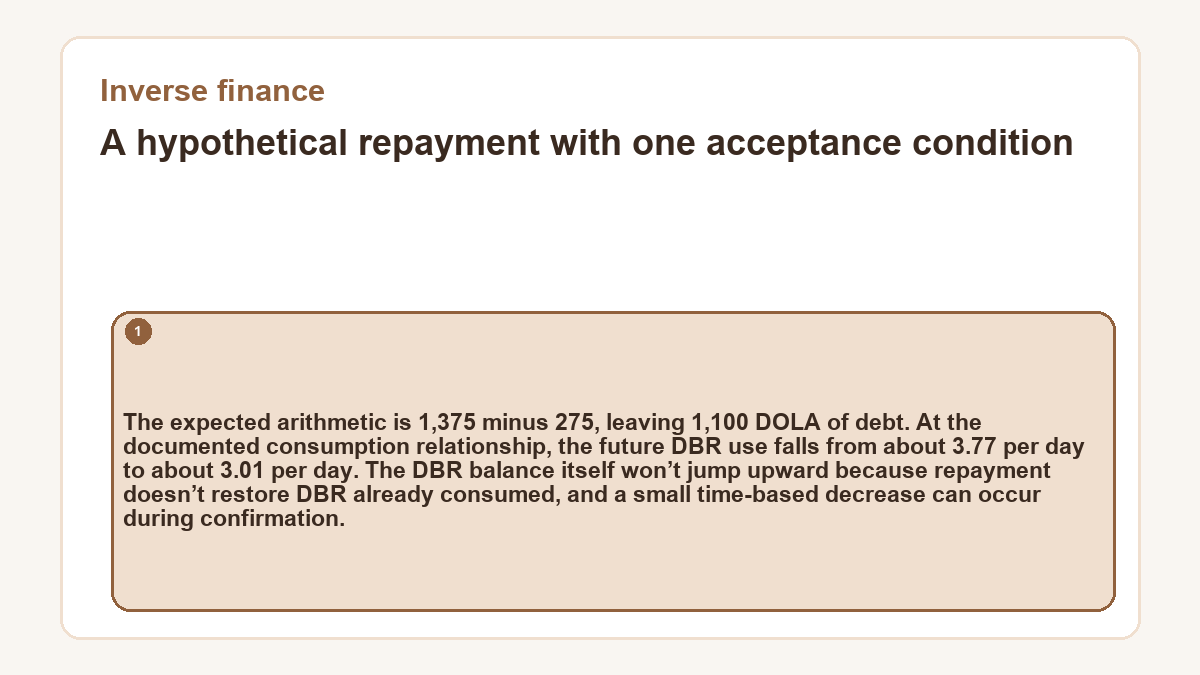
The expected arithmetic is 1,375 minus 275, leaving 1,100 DOLA of debt. At the documented consumption relationship, the future DBR use falls from about 3.77 per day to about 3.01 per day. The DBR balance itself won’t jump upward because repayment doesn’t restore DBR already consumed, and a small time-based decrease can occur during confirmation.
Check whether the transaction is pending or has a successful or failed receipt, then match its account and action to the intended repayment. If it only approved DOLA spending, the debt should still read 1,375 because repayment hasn’t occurred. If the repayment succeeded and the on-chain position reads 1,100, the interface can be refreshed without sending another transaction.
Continue only after the same market records 1,100 DOLA of debt. A pending transaction calls for waiting. A failed receipt or an approval-only action calls for stopping and identifying the missing repayment before signing again. This sequence avoids treating a wallet notification as proof that the repayment changed the position.
Which mismatch requires action first?
A liquidatable collateral position has the most immediate consequence because third-party liquidators may repay debt and seize collateral under the market’s rules. A DBR balance near or below zero needs prompt attention because a negative balance makes the position eligible for forced replenishment, which can increase debt without delivering additional DOLA. If both conditions appear together, adding DBR alone won’t remove the collateral shortfall.
Other mismatches are diagnostic rather than economic. A confirmed approval with unchanged debt means the spending permission changed but repayment didn’t occur. A falling DBR balance alongside unchanged debt can reflect normal time-based consumption. A position missing from one view may indicate that the wrong wallet or collateral market is selected. These cases call for checking identifiers and state before changing the position again.
Keep recovery bounded to the mismatch. Recheck the receipt, account, market and relevant balance. Don’t sign a replacement merely because a display is slow, and don’t expose a seed phrase or private key while troubleshooting. Public transaction details and visible position values are sufficient for comparing the recorded start with the on-chain outcome.
Verification changes the choice between retrying and waiting
A recorded baseline turns an uncertain interface message into a specific comparison. It shows whether debt moved, collateral changed, DBR kept depleting normally or an action never reached the position. Continue after a matching state, wait while confirmation is unresolved or stop when the receipt shows the wrong action. Compared with retrying from memory, a before-and-after record exposes both completion and material mismatches.
Inverse finance - common questions
-
Can a failed FiRM transaction consume gas without changing DOLA debt?
- Yes, a failed on-chain transaction can consume gas even though its requested state change reverts. The receipt should show failure, while the FiRM position should retain its earlier debt and collateral state. Compare the updated position with the starting record before retrying. A separate approval may also consume gas and succeed without changing debt because it grants token spending permission rather than performing the repayment.
-
Does a partial repayment restore DBR that has already been consumed?
- No, repaying part of the DOLA debt doesn’t recreate DBR that was previously consumed. It reduces the outstanding debt, so DBR depletes more slowly afterward. Any unused DBR remains in the wallet and can continue covering the smaller loan. Check the new debt value and projected coverage separately, since a lower future consumption rate isn’t the same as a higher DBR balance.
-
Which identifier distinguishes a token approval from a completed repayment?
- The transaction hash identifies the exact on-chain action and lets the receipt be matched to the submitting wallet. An approval changes the amount of DOLA that a contract may spend, while a repayment reduces the position’s DOLA debt. If the receipt represents only an approval, unchanged debt is expected. Confirm the action type and updated debt before assuming the repayment was completed or sending another transaction.
-
Is it safe to share a FiRM troubleshooting record with someone else?
- Sharing such a record doesn’t expose wallet credentials if it contains only public details such as the wallet address, transaction hash, market and visible position values, but those identifiers can reveal the account’s public activity. Remove unrelated account information when it isn’t needed. A seed phrase, private key, recovery file or wallet password must never be included. Public records help identify the account and transaction; secret credentials give control over assets and aren’t necessary for checking an outcome.
Updated on